In John Baglio’s Applied Engineering Research class, Fieldston Upper students spent the year learning the practical skills engineers need. While developing their proficiency in AutoCAD, practicing 3D printing, and sourcing electronic components, students were also honing the creativity, perseverance, and collaboration that make a truly great engineer.
The Applied Engineering Research class is a hands-on lab where students undertake an independent research and design project. The project begins with a prompt from Baglio, who asks them to consider a problem in the world they would like to solve. Throughout the year, students engage in a full engineering design process, starting with ideation, then moving on to research, prototyping, and iteration. The final result is a product that reflects the challenges and triumphs of a year of collaborative and experiential learning.
We interviewed the 2026 Applied Engineering Research cohort to learn more about their process and final products.
Kevin N. ’26
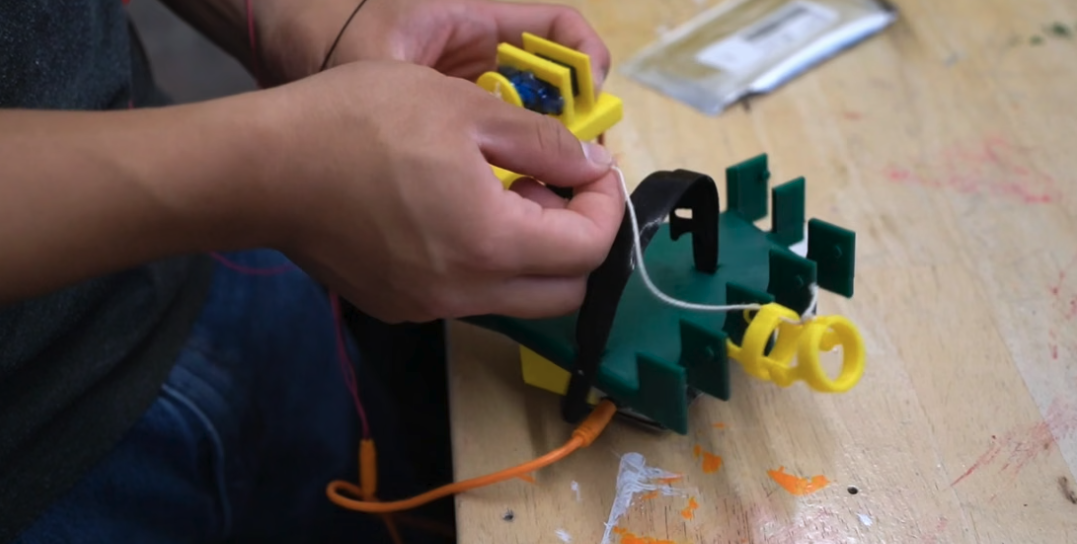
“Accessibility was really important to me,” explains Kevin when asked about the initial impetus for his 3D printed grip assistive device. “Some of these devices have such a high price point, so doing something simpler, especially with 3D-printed parts, makes it a lot more accessible.”
After researching the current market for grip-assistive devices, Kevin realized there was a gap for a simple, less expensive, and potentially DIY-able version. After an initial prototype that used tensioned PLA proved to be inflexible, he pivoted. “This design uses a motor and a spiker bit that measures your EEG through electrode sensors attached to your arm,” he explains. The new design also features elements he’s particularly proud of. “One of my favorite things about the design is the way the finger modules snap together. All you have to do is press them together, and they just fit almost perfectly.”
Aiden E. ’26, Zoe G. ’26, Mia H. ’26
Seniors Aiden, Zoe, and Mia’s invention was initially intended to solve a problem that affects their local community. “I wanted to think of some sort of place that could improve the quality of life for homeless people in the city,” explains Aiden. As they prototyped their product, they found it had use cases beyond their initial idea. “We took that idea and applied it to disaster relief, where we wanted something that’s stable and insulated, but at the same time, easily portable,” the students explain.
Their final product, a series of modular triangular panels inspired by MagnaTiles, creates an insulated dome with customizable windows and locking mechanisms to withstand high winds and debris, made of a lightweight material that allows for easy shipment. “Even though we’re at the end of the modeling stage, it’s still early on in the production stage,” the students explain. “Now, we’re thinking about how it would hold up long-term in weather conditions, in snow, in extreme heat, and extreme rain. You just have to test that stuff out.”
Ava A. ’26, Nico B. ’26, Avery S. ’26
By combining a shared interest in psychology, a variety of engineering disciplines, and a desire to create something that could support their classmates, this group chose to build a lamp programmed to lower the user’s blood pressure and reduce anxiety. “We all wanted to combine what we’ve done over the last four years, meaning CAD design, coding, and mechanical and electrical engineering,” explains Avery. “We decided to make a lamp that would help bring your heart rate down using box breathing.”
The group chose to split up the coding and drafting elements of their project, but reconnected to problem-solve when challenges arose. “One of our big challenges was getting the two different coding languages to talk to one another,” explains Nico. “The heart rate monitor is on the Arduino, and the lights are coded on Microbit. Getting those two to talk to each other, especially when the heart rate reaches a certain point, and the color is supposed to change, has definitely been our biggest challenge.”
Andrew C. ’26
Andrew C. ’26’s invention, a study timer with a paper-like interface, combines the digital minimalism movement with a tactile and satisfying user experience. “As technology is advancing, the gap between productive use and compulsive consumption has narrowed,” he explains. “My project fills the gap of a smart study tool that can organize your time for you without having added distractions and multifunctionality.” The invention supports students who are interested in studying without their phones but still want some structure by using the Pomodoro study method, which automatically divides a larger study session into smaller chunks, or “pomodoros,” and breaks.
“My goal is to be able to share it so other people can replicate it,” Andrew says. “I’m working on a GitHub repository for it, where I’ve been sharing the 3D print files and the code, so that other people can go through my same process and then have one of their own.” His hope is that the product provides support to anyone looking for a study tool that supports focus, rather than spiking dopamine.
Freya M. ’26, Zauditu S. ’26, Noah S. ’26
This group was inspired by a shared frustration with their pets. “We can’t have plants out because our cats would always eat them,” shares Noah. The solution they came up with was a cat deterrent system that was minimally invasive to humans, while also being effective. “Our product uses three infrared sensors that will send a signal to a microbit when they detect motion, which then sends a signal to a speaker that emits a noise that hopefully scares off a cat,” says Zauditu.
As the group was prototyping, they ran into a challenge with their tests. “Because we wanted something that humans can’t hear, it’s very hard to test whether it actually works,” Noah explains. “We’ve connected it to a light that turns on when it senses motion, but it’s very hard to prove that it works to deter cats, and we’re currently working through that.” As the group continues to explore, they hope to 3-D print a casing and run more tests to confirm that the deterrent is strong enough.
Jack M. ’26, Federico PH. ’26, Zac W. ’26
A shared interest in aviation has bonded Zac and Federico since 7th Grade. They teamed up with Jack to create a new model for low-cost airplane travel. “By creating a standing seat, we would be able to increase capacity on planes by 30-50%, meaning that airfares could be reduced by 50%,” explains Federico. Their standing seat uses a unique frame construction to distribute a plane’s G-forces over a larger area.
“The seat is structured with six plywood profiles, which are shaped like hockey sticks,” Jack explains. “The ones in the middle are the longest, and then they taper off like a bicycle seat. That way, it’s the most comfortable it can be.” The unique construction also helped them avoid a potential point of failure at the seat joint. “By using the profiles, we never had to worry about the strength of a joint, because it was all connected.” The group sees their updated model as a way to reduce the total number of flights an airline needs to operate, thereby also having an environmental impact.
Kiran G. ’26 and Sophia T. ’26
Kiran and Sophia worked together to create an invention to solve an issue that affects them and their peers almost every day. “Sophia had the idea that often, there’s something that makes us uncomfortable physically,” Kiran reflects. “Maybe in one room the humidity is high, or the AC doesn’t work, and it’s hard for an administration to keep track of all of the rooms at once.”
Their solution was a low-profile box that houses a variety of sensors, each of which feeds back into a central database that allows an institution to analyze the data from each classroom collectively. While Sophia worked on drafting and 3-D printing the case, focusing on keeping the individual components low-cost, Kiran worked on the programming. Their ultimate goal was creating “These very innocuous things spread across a building that simultaneously function together and give you this wide array of data you couldn’t get otherwise.”
Gavin L. ’27
Gavin, the only 11th Grader in the class, looked to his local environment to find a problem he was passionate about solving. “I live really close to the pier, so I always walk around and see pollution in the Hudson River and trash left around,” he reflects. The solution he invented was an ROV, or remotely operated vehicle, that glides along the water’s surface to pick up trash.
What makes Gavin’s invention unique is its shape, which is modeled after a manta ray. “I did a lot of research about incorporating the biomimicry aspect of it,” he explains. “The manta ray’s body is very hydrodynamic and cuts through the water instead of floating like a boat or other vehicle.” As part of the design process, he learned to draft the model digitally in OnShape, a CAD software, before 3-D printing a series of prototypes that he’s currently experimenting with to find the best way to waterproof his electronic components.
Noah B. ’26
Noah’s initial idea also focused on conservation and sustainability. “I created a device to sort trash using artificial intelligence,” he explains. “There’s a lot of data in the world, so it’s integrated with the data sets we already have, and with the trash cleaning robots that already exist.” The use of cutting-edge technology tasked with a sustainable mission is a combination he’s interested in continuing to explore. Noah’s invention fits into a larger system, but uses the capabilities of artificial intelligence to create an adaptable model that could be used worldwide.
“You use a camera to look at a piece of recycling and sort it between what we have here, which is the blue and green bins, but you train it based on what you have, and it gets better over time,” he says. As he continues to ideate on his invention, his ultimate goal is to create his own artificial intelligence system that’s specific, rather than using an “off-the-shelf” AI model.