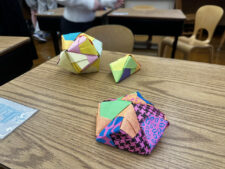
As 5th Graders inch closer to middle school, their natural gravitation toward play may look a little different than it did in years prior. In Ethical Culture’s 5th Grade Math Club, play becomes a factor during lessons on probability in the form of simple games of chance.
For Math Specialist Larry McMillan, the playful nature of math takes shape as he introduces more complex possibilities.“Math Club is a place where we can explore the types of mathematics that don’t get invited to math class,” he said. “I give each of the classes a taste of Math Club in the fall, so everybody can make an informed decision.”
During this preview, McMillan often begins with fractal design. Students construct a Sierpiński gasket through technical drawing, combining precision with creativity. Incorporating visual elements often makes math more approachable, especially for students who may need another way of accessing mathematics, helping them reach an outcome more easily than a traditional method. “It’s a fun drawing exercise, and the fractal goes on forever,” shared McMillan. “That hooks in students who would not think, ‘I’m an advanced math learner, so I should be at Math Club.’”
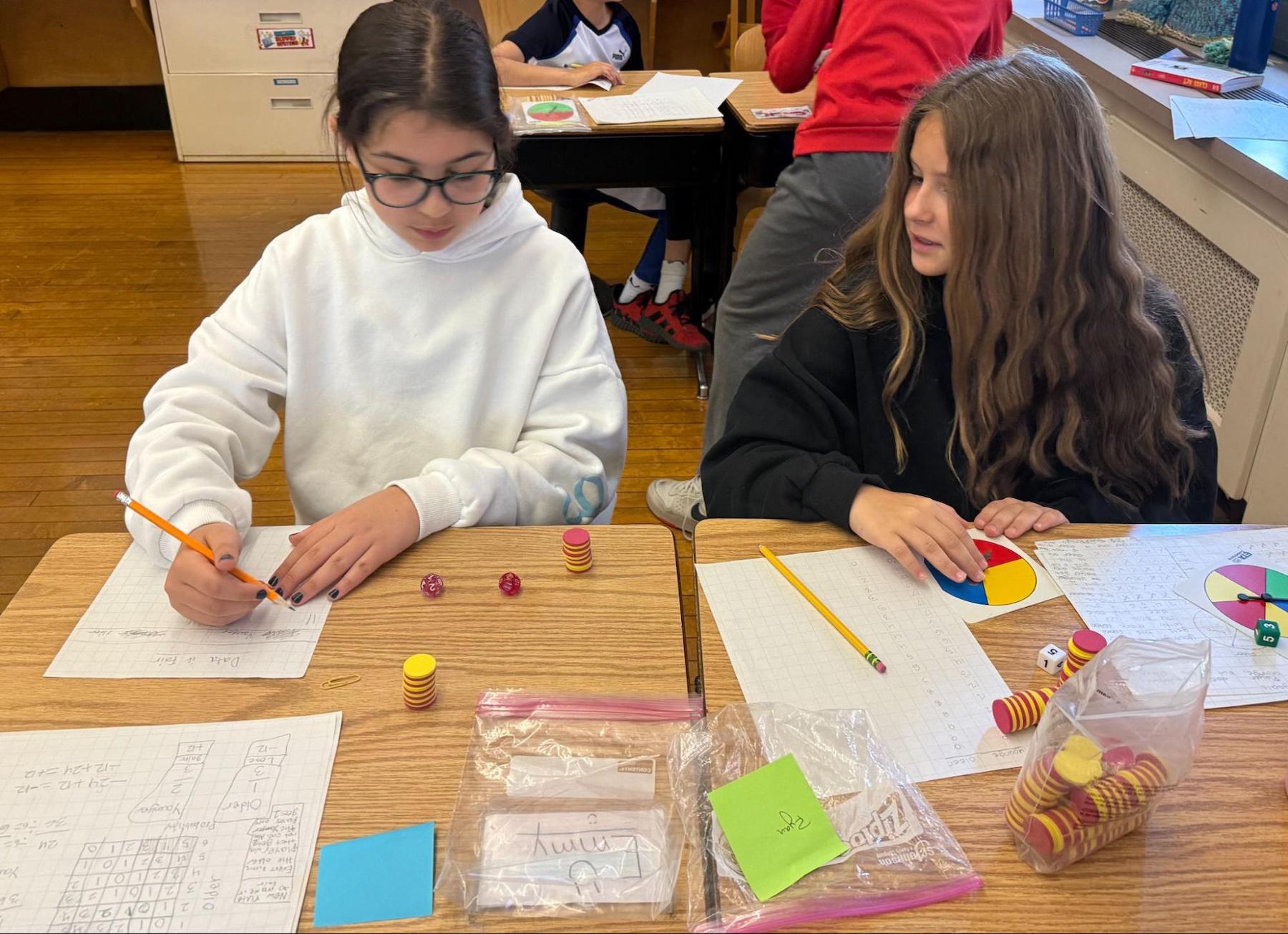
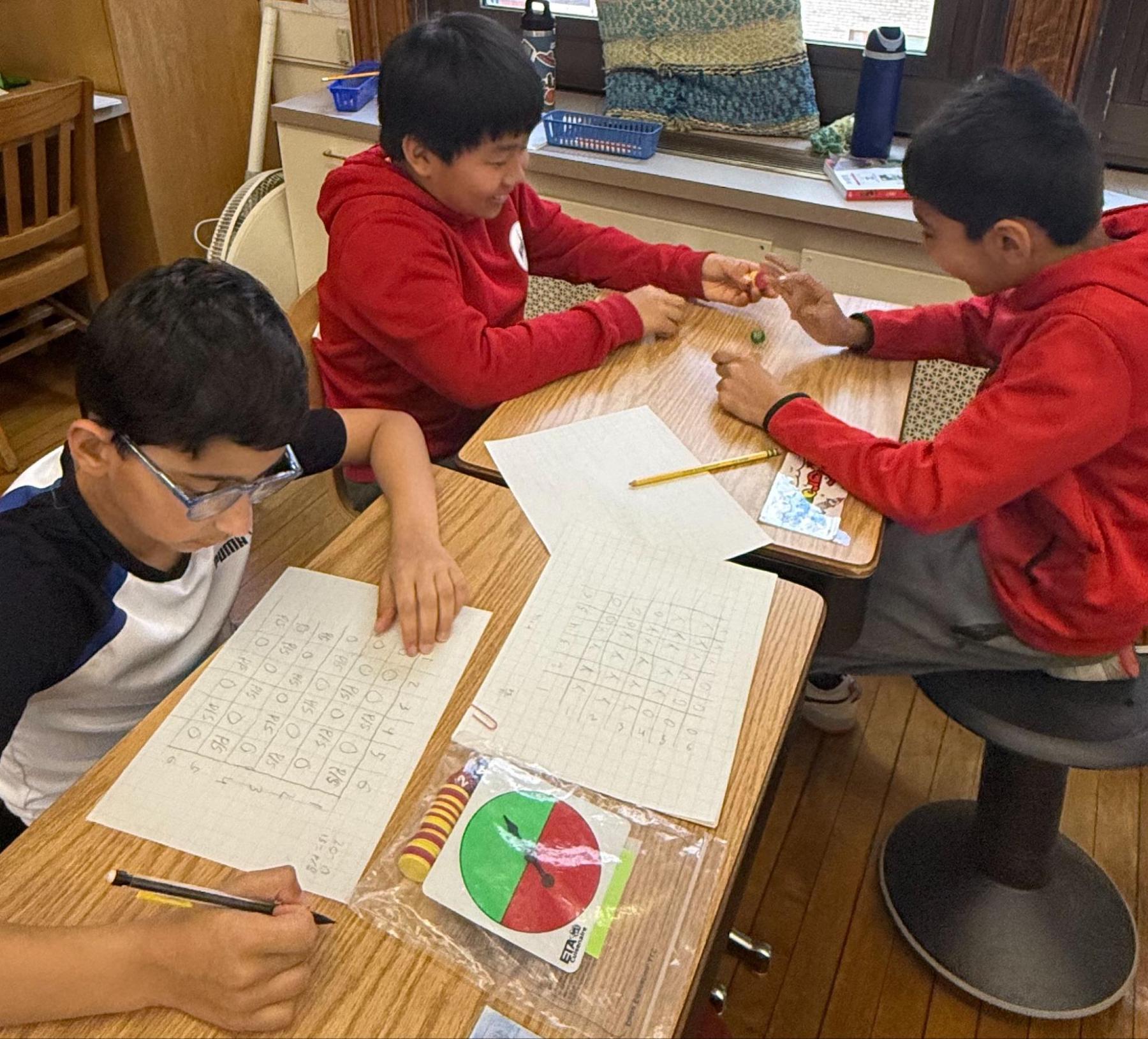
When the club turns to studying probability, students are introduced to McMillan’s game, “Product Dice.” Each player starts with five tokens and takes turns rolling two dice. If the product is even, the older player gives the younger one a token, and if the product is odd, the younger player gives one back. At first glance, the game seems fair.
Then they begin to play.
Very quickly, patterns start to appear. The younger player seems to win the game every time, leading students to believe the game is unfair. As they continue playing and tracking outcomes, they determine that the older player wins about a quarter of the dice rolls, leading to a definition of experimental probability and an explanation of the sample space, which shows all possible outcomes of an event.
Determining the sample space settles the debate of fairness. “If you got every possible outcome in your sample space, what would the result be then?” McMillan asks. “That’s your expected value.” Students come to understand that when the expected value is zero, a game is fair.
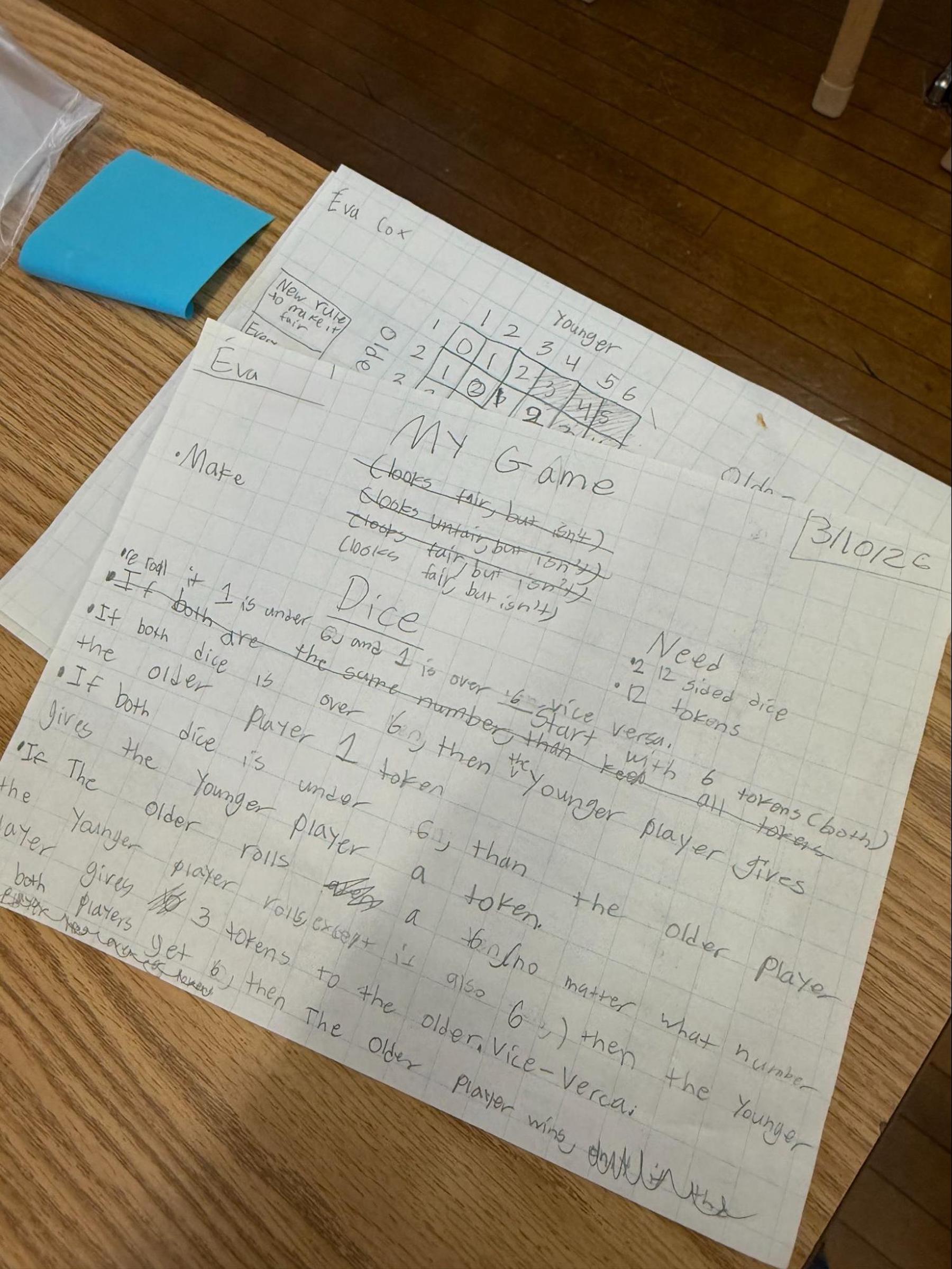
With that foundation, 5th Graders move on to designing an original game, which tests how well they understand expected value, or the average outcome of a variable over time. Students build their games with the goal of making the rules either fair or unfair, which proved to be an ever-evolving challenge.
“Many students really get it and can design a game from the outset to be either fair or as unfair as they want it to be,” McMillan shared. “Others play around with it, and maybe they get a result that’s not really what they wanted, so they tweak it and do something else.”
The process also introduces students to mathematical tools that they will likely encounter in future classroom studies. This year, one student designed a game with a bespoke die and spinner, learning to use a drawing compass to draw a perfect circle and a protractor to size its sectors correctly. “They had to think about central angle measure,” McMillan explained. “How much rotation would you get in one sixth of a circle?”
Another group aimed to create a fair game but ran into a problem when the same player kept winning during their test rounds. “They became concerned that the game was unfair, and we talked through the sample space that they made. They were able to determine that the game really was fair, and that they would reach more predictable results by making it longer.”
“We focus on keeping the games simple in order to see the probabilities clearly,” McMillan said. “If you design a complex enough game, you’ll never figure it out. That hasn’t happened. I’ve certainly seen a lot of them also bring an artistic flair to the work, which is definitely part of the joy for those students to do it that way.”
During a recent Math Club meeting, students shared their finished games, succinctly explaining the rules and sample spaces that determined fairness. As they organized their game notes, one trio shared, “We’re thinking about making new ones!” and turned to McMillan, asking, “Can we make another game?”
For McMillan, this moment is a prime example of the lesson’s value: learning a concept and simultaneously discovering its joy and fun. Providing the space to explore increasingly complex mathematical concepts through the fun of trial and error, Math Club emphasizes how chance and probability can lead to genuine learning and joy.